Published 3 minute read
At the bench: shaping, soldering, polishing, plating
What happens to a piece of silver between the bench and your hand: the main steps of making jewellery, explained simply, from the first cut of metal to the final layer of gold.
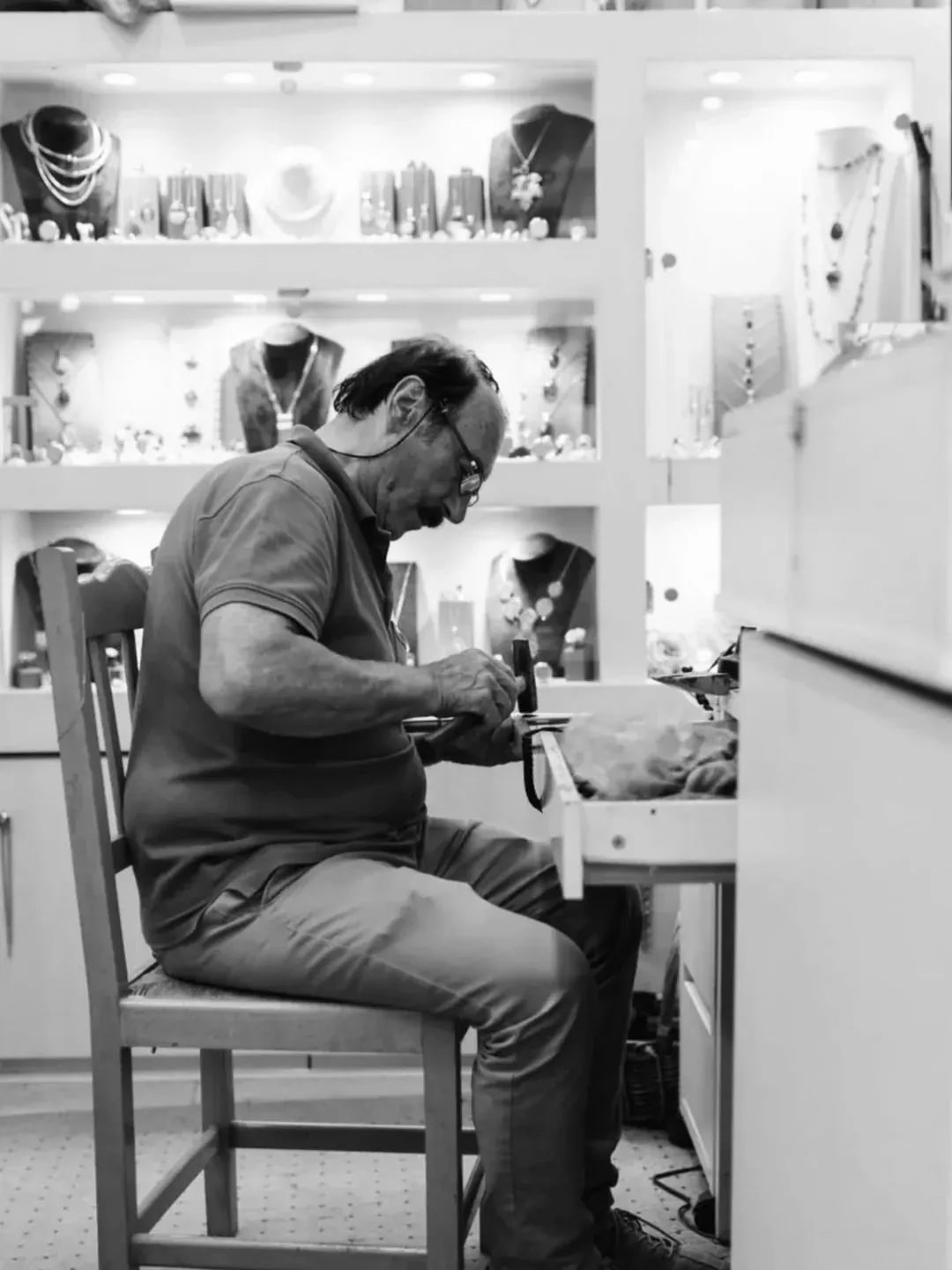
A goldsmith’s bench is a small place where a great deal happens. It has a curved cut-out so the maker can sit close to the work, a wooden peg to hold the work against, and within reach a rack of pliers, files, saws and a small torch. Ours stands in the shop in Metsovo, among the display cases. This, in plain words, is what happens there.
Shaping. Silver arrives as wire, sheet and tube. It is cut with a fine saw, filed, and bent with pliers around steel cones and cylinders: a ring around a tapered cone, a hoop around a round bar. Metal hardens as it is worked, so between steps it is heated until it glows faintly and softens again; this is called annealing.
Texture. A hammered surface is made by striking the metal again and again with a hammer whose face is polished or textured. Every blow leaves a small facet, and together they catch the light unevenly. A rope texture is made before the wire becomes a piece of jewellery: two wires twisted together make a rope.
Soldering. Where two parts meet, such as the ends of a ring, a link closing through the next one or a pendant joining the loop it hangs from, the goldsmith uses solder, an alloy that melts at a slightly lower temperature than the piece itself. A small flame heats the joint, the solder flows into the seam and the two parts become one. Done well, the join cannot be seen.
Setting. Stones are held by the metal itself. In a claw setting, small prongs are bent over the edge of the stone; in a bezel, a thin wall of metal is pressed around it. Our cubic zirconia stones sit in four-claw settings and our cabochon in a bezel. It is slow, close work, done under magnification.
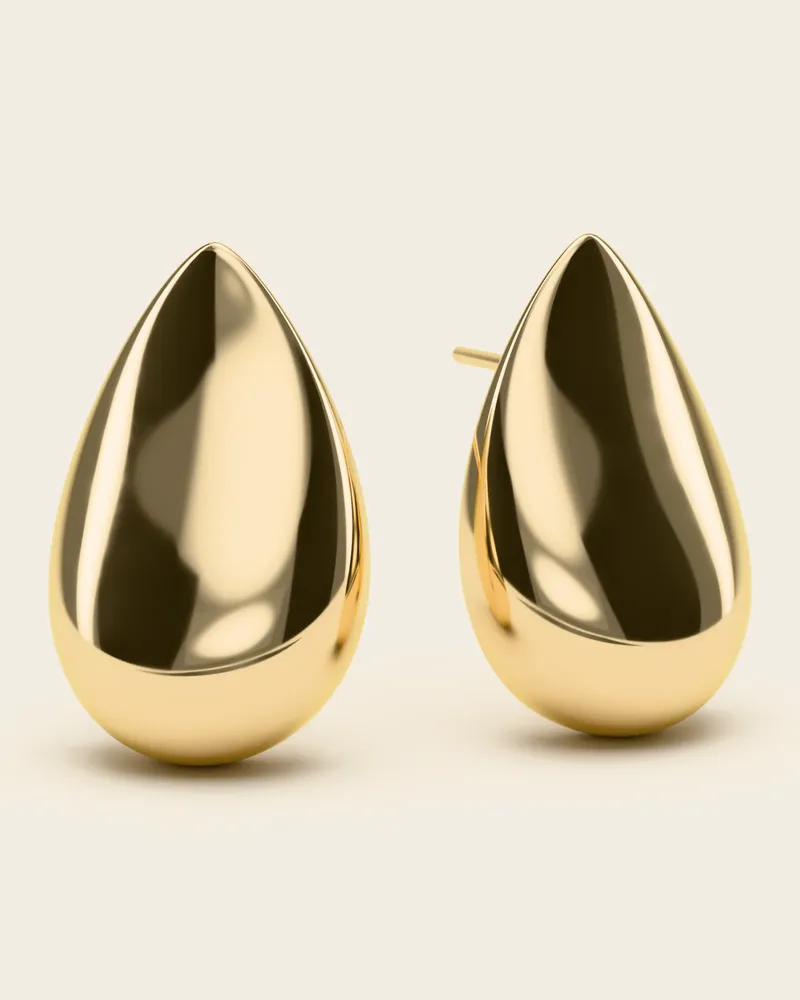
Polishing. After the joins and the settings comes the finish. Files and fine abrasive papers take away the marks; then polishing wheels with ever-finer compounds bring the surface up to a mirror shine, as on our Aoos drops, or stop at a soft satin. A hammered surface is polished only on its high points, so that the texture stays.
Plating. Gold-plated pieces go through one more step. After a thorough clean, the silver piece is placed in a bath containing gold, and a small electric current lays a thin, even layer of gold on its surface. The thicker the layer, the longer it lasts. [PLACEHOLDER: owner to state the thickness and caratage of the plating, and whether it is done in the shop or by a specialist plater.]
Checking. Last comes the part of the work that nobody sees: a good goldsmith opens and closes every clasp, checks every stone for movement and runs a fingertip along every edge so that nothing catches. Then the piece is cleaned once more and packed.
Three generations of hands have learned these steps in our family, and the work is still done by hand. [PLACEHOLDER: owner to add, in their own words, how they learned the craft and which steps happen at the bench in Metsovo.]
Pieces in this article
Aoos Dome Drops
Gold-plated 925 silver · and 1 more finish
from €49






Read next
2 minute read
How to care for gold-plated silver
Most of our jewellery is gold-plated 925 silver. A few simple habits keep the gold layer bright for longer: what wears it, what protects it, and what to do when it thins.
2 minute read
Finding your ring size
European ring sizes are simply millimetres. Three ways to find yours at home, why the time of day matters, and what to do about a wide band or an open ring.
2 minute read
Layering necklaces and huggies
Two or three necklaces at different lengths, a huggie in a second piercing, one bold piece and a few quiet ones: a short guide to wearing several pieces together, the way we photograph them.